Challenge accepted.
October 13, 2025
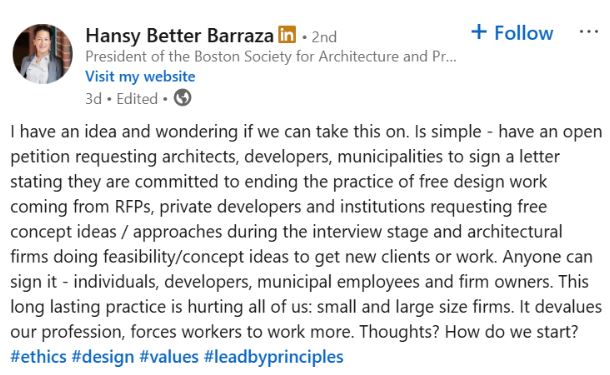
The Boston Chapter of The Architecture Lobby stands firmly against the practice of unpaid design competitions and design performed during the interview process. Production of unpaid design diminishes the value of design labor, exacerbates inequality, and promotes exploitative work practices.
By requiring unpaid design as a part of competitions or interviews, or to win a new client relationship a client is in fact setting up a pay-to-play model for the possibility of winning a contract. By giving away design labor for free, an architect is forfeiting their ability to gain value for their labor and indicating to clients that first, architects don’t value that labor and as a result, design labor is not worth paying for. Because of this de facto pay-to-play model of participation, the practice of unpaid design in competitions and interviews benefits large firms at the expense of small firms hoping to grow. The firms able to produce higher quantities of design competition submissions are the firms that already have more resources to burn freely. Smaller firms operating with smaller budgets must take much bolder risks in joining these competitions, even if they are equally qualified. Ultimately this is a losing proposition for all firms regardless of size, as it creates a race to the bottom in who can provide the most unpaid work.
While design is a value architects bring to any project, design shown during the competition or interview phase does not indicate any ability to manage a project through completion, act in productive relationship with the owner and consultant teams, or stick to a proforma’s budget. A portfolio of past work – both completed or unfinished – should be a sufficient indicator of the design capabilities of an office. Even among the strongest allies of small firm and minority/woman-owned firms, there is an ingrained practice of requesting designs and not using them as a strong criterion for RFP awards; the proforma and team structure are often the deciding factor.
Finally, unpaid design promotes exploitative labor practices. If the work presented by the office is unpaid by the client, are the workers of the office also unpaid? Unfortunately, the answer is too often “yes.” Due to competition, offices are incentivized to impress the client in order to win the work, which often leads to overtime work by the staff. Architectural overtime work is not required to be paid due to categorization as “professional” by the US Department of Labor. In a survey conducted by The Architecture Lobby with responses from 236 architectural workers, over 50% said they worked at least one weekend per month and 60% reported working at least 45 hours per week – many hours that go unpaid.
The Boston Chapter of The Architecture Lobby sees unpaid design labor in competitions and interviews as a practice that should end. We believe a living wage with healthcare and paid overtime should be provided to all workers.
We urge members of the industry to pledge their rejection of unpaid work and embracement of the value of design labor. The pledges included here offer design firms, design clients, and individual architectural workers to take a public stand and allow The Architecture Lobby to broadcast their rejection of unpaid labor. With sufficient collective consensus, this race to the bottom will end and the value of design labor will be upheld.
In solidarity
-The Boston Chapter of the Architecture Lobby
PLEDGES
Client // Individual // Firm // AIA Chapter (coming soon)
CITATIONS
Designing Procurement: The Case for Competitions, pg 14 — Susanne Schindler, Harvard Joint Center for Housing Studies
PLEDGED FIRMS AND INDIVIDUALS